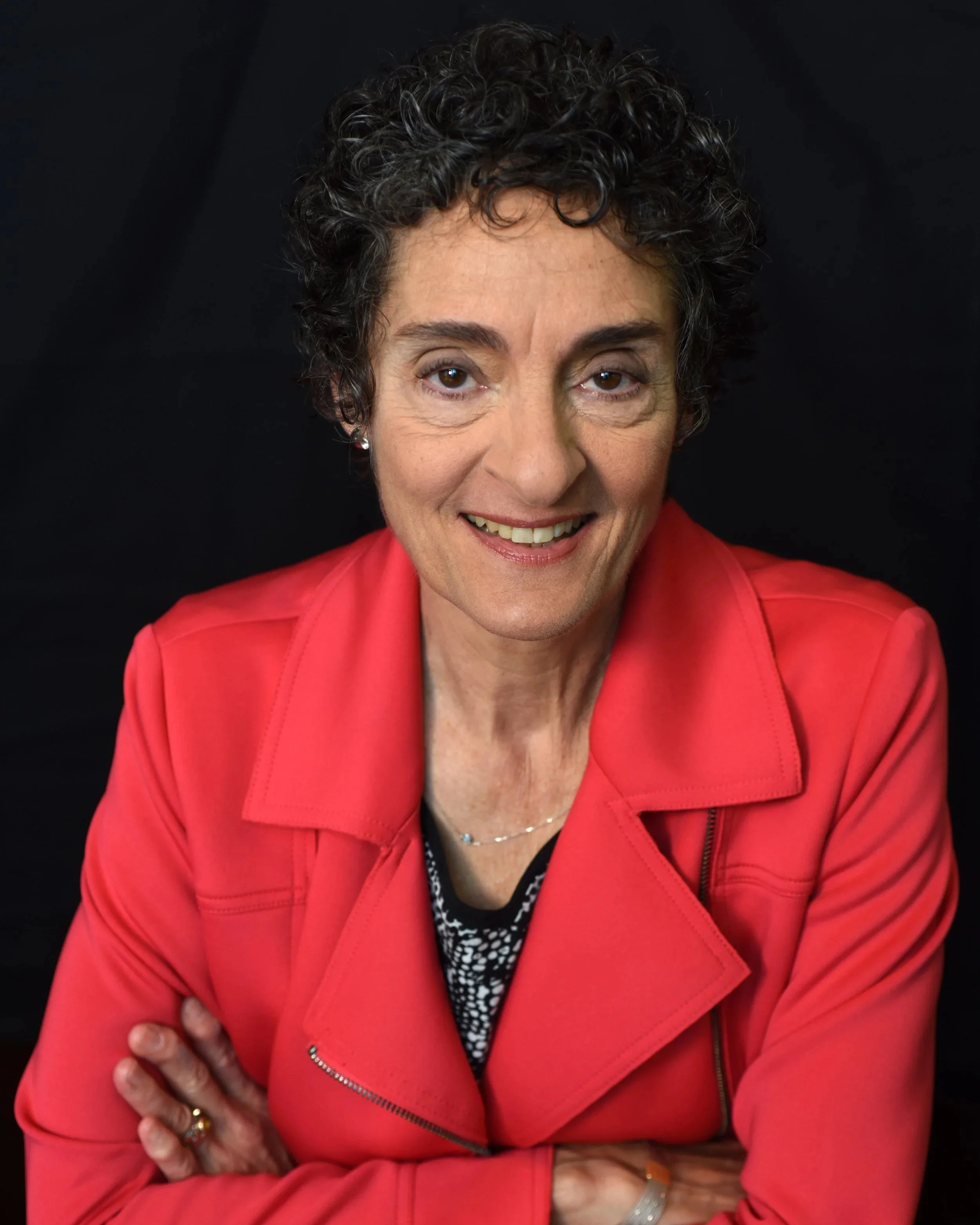
Dr. Carla Shatz
Photo by Peter Badge
Professor, Stanford University Departments of Biology and Neurobiology
Postdoctoral Fellow, Harvard Medical School
PhD, Harvard University
Carla Shatz was raised by an aeronautical engineer and mathematician father and an artist mother. Together they nurtured in her a special combination of creativity, curiosity, and unyielding tenacity. In an era when women were only beginning to be accepted into higher education in the sciences, Carla stepped into academic spaces without a clear blueprint for navigating the barriers women faced. Nevertheless, she persisted and flourished, uncovering principles of early brain development that now form core tenets of neuroscience. Today, Dr. Carla Shatz and her lab at Stanford University continue to investigate how the mammalian visual system develops, and how these insights can inform our understanding of neurodegenerative disorders such as Alzheimer’s disease.
In 1969, when Carla entered Radcliffe College (a women’s liberal arts college, which has since merged with Harvard University) as an undergraduate student, neuroscience did not yet exist as a formal discipline. Though she majored in Chemistry, Carla sought a senior research experience that could weave together her love of science and art. This ultimately led her to the physiology of vision. She joined the lab of Drs. David Hubel and Torsten Wiesel in Harvard Medical School’s new Department of Neurobiology, first for her undergraduate thesis and eventually returning for her PhD in Neurobiology in 1976—becoming the first woman in the Department of Neurobiology at Harvard to earn this degree.
At the time, Hubel and Wiesel were two young physiologists conducting groundbreaking work on how information from the eye is organized and processed in the visual cortex, which would eventually earn them a Nobel Prize. Carla’s doctoral research focused on how the visual system can adapt in the face of misrouted connections from the eye. In the Siamese cat, a genetic mutation causes optic nerve fibers to travel to the wrong side of the brain, leading to visual abnormalities such as crossed eyes, poor depth perception, and altered contrast sensitivity. As a result, the visual cortex receives information coming from the entire visual field rather than just one hemifield. Using electrophysiology and anatomical tracing, Carla found that connections can reorganize in a manner that preserves an orderly map of visual space at the expense of binocular vision—one of the first examples of early developmental plasticity in the visual system. Together, these experiences piqued Carla’s curiosity about visual circuit development—how does the adult visual system become organized in such an intricate manner?
To pursue this question, as a postdoc and Harvard Junior Fellow, Carla continued her research with Hubel and Wiesel and also joined the lab of Dr. Pasko Rakic at Children’s Hospital, Harvard Medical School. With Rakic, she learned how to study early neural development from one of the first scientists to investigate brain development in utero in nonhuman primates. She brought these approaches to her own lab at Stanford University Medical School, where she became the school’s first woman to be appointed as an Assistant Professor in Neurobiology 1978, and in 1989 the first woman promoted as a full Professor in any Basic Science Department at the Medical School. Through detailed tracing and physiology experiments of the cat visual system, Carla and her lab made a surprising discovery: the eye-specific visual system connections seen in adults are not in place in the embryo. Contrary to prevailing beliefs that these circuits were hardwired, they instead found that adult patterns of neural connectivity only emerge through extensive remodeling. In embryos, the visual system’s connections exist in a diffuse and imprecise manner, forming prior to eye opening and visual experience, and are later remodeled and refined both structurally and functionally.
To understand how this refinement occurs, Carla turned to using in vitro multielectrode arrays to make electrophysiological recordings across developmental stages. Her lab discovered that early embryonic visual system connections are already “working”: spontaneous patterns of activity are relayed from the retina to the lateral geniculate nucleus (LGN) of the thalamus even before the onset of vision. While unexpected, this principle of spontaneous activity-driven circuit refinement has since been observed across many brain regions and species. Based on prevailing computational models, Carla expected this spontaneous activity would be largely random. Instead, the lab observed that this activity is actually highly coordinated, with wave-like bursts of activity sweeping across the developing retina. Although initially dismissed by some as a mere technical electrophysiological artifact—a common fate of discoveries enabled by new methods, or made by early-career researchers, especially women—the finding gained credibility through complementary calcium imaging studies, another novel technique which provided a means to directly visualize retinal waves under the confocal microscope. The Shatz lab further demonstrated that these waves were necessary for visual system development. Manipulating them in vivo disrupted the transformation from an immature circuit to a mature, highly segregated visual system.
Together, these findings provided a foundation for a now-familiar idea in neuroscience: neural circuits are shaped by activity-dependent plasticity. As Carla began teaching at Stanford, and eventually at UC Berkeley, about these mechanisms, she searched for a way to distill this challenging concept for her students. She landed on the phrase “cells that fire together, wire together”—inspired by Hebbian theory. This simple saying, published in Scientific American in 1992, emerged as a pedagogical tool that every neuroscientist in training is now taught. Carla also emphasized the important converse: “cells that fall out of sync lose their link.” Plasticity, she teaches, is not only about growth, but about loss. This balance between strengthening and pruning is still a central theme of her work today.
Over time, Carla became interested in which molecular machinery translates loss of synchrony into the physical pruning of synapses during development. While much was known about how activity induces gene expression to strengthen synapses, far less was understood about the downstream signals that disassemble them. To address this question, the Shatz lab examined changes in gene expression caused by blocking spontaneous activity in developing visual circuits. They were surprised to find that many of the genes most strongly correlated with synaptic pruning were immune-related, including major histocompatibility complex class I (MHC I) molecules. This insight opened a new line of inquiry with profound clinical implications, since synapse loss is also an early feature of Alzheimer’s disease. The Shatz lab set out to determine if they could protect against excessive synapse degeneration in a mouse model of Alzheimer’s disease using information learned from her studies on development. They found that a neuronal receptor for MHC I is overactive in these mice, and when this receptor was removed, mice were protected from cognitive decline, even in the presence of high levels of amyloid plaques. These findings point toward a unifying idea that Alzheimer’s may be in part a disorder of excessive or unsupervised synaptic pruning—and that mechanisms first used in development may re-emerge maladaptively in neurodegeneration.
Carla is acutely aware of how experience shapes outcomes, whether in neural circuits, career development, or personal life. Carla was the first woman to earn a PhD in Neurobiology at Harvard. Later, after faculty appointments at Stanford and UC Berkeley, she returned to become the first woman to chair Harvard’s Department of Neurobiology, the same department where she had trained as a graduate student. At the time of her training, there were few women role models in STEM, and she later learned that her Harvard admission had been debated by faculty who were uncertain if investing in a woman scientist was worthwhile. Shielded in part by supportive mentors and parents, an upbringing that made her “impervious enough” to persist, and an optimistic disposition, Carla focused on the joy of discovery. At the same time, she has been candid about the personal costs of navigating a scientific career that had few institutional structures to support women and family life. She carries with her a sadness for the biological children she was unable to have, and for the toll it took on her marriage. However, these experiences made Carla an extraordinarily dedicated mentor, committed to her “lab family” and to nurturing the next generation of scientists, ensuring they have the support they need to succeed.
Carla stands as both witness and architect of the evolution of neuroscience as a field. Today, as investment in basic science research is in jeopardy, she has come to be deeply concerned about the future of basic research. Many of the insights that now anchor neuroscience—from spontaneous activity to synaptic pruning to immune-brain interactions—were not obvious translational targets when they were first discovered. They emerged because curiosity-driven basic research allowed them to unfold. “Who could have imagined,” she asks, “that studies of visual development would one day inform how we think about Alzheimer’s disease?” Now, as the Director of Stanford Bio-X, Carla guides the university to fund high risk, interdisciplinary, early stage research and training with the goal of advancing knowledge by supporting the pursuit of genuine breakthroughs.
For Carla, answers lie in trusting the process of discovery science itself: following questions wherever they lead, cultivating diverse perspectives, building environments where young scientists are supported to succeed, and taking time to let your mind rest and body move. Her story serves as a reminder that the brain, like the enterprise of science, builds itself through exploration, revision, and care.
Find out more about Carla and her lab’s research here.
Listen to Nancy’s full interview with Carla on August 1, 2025 below!