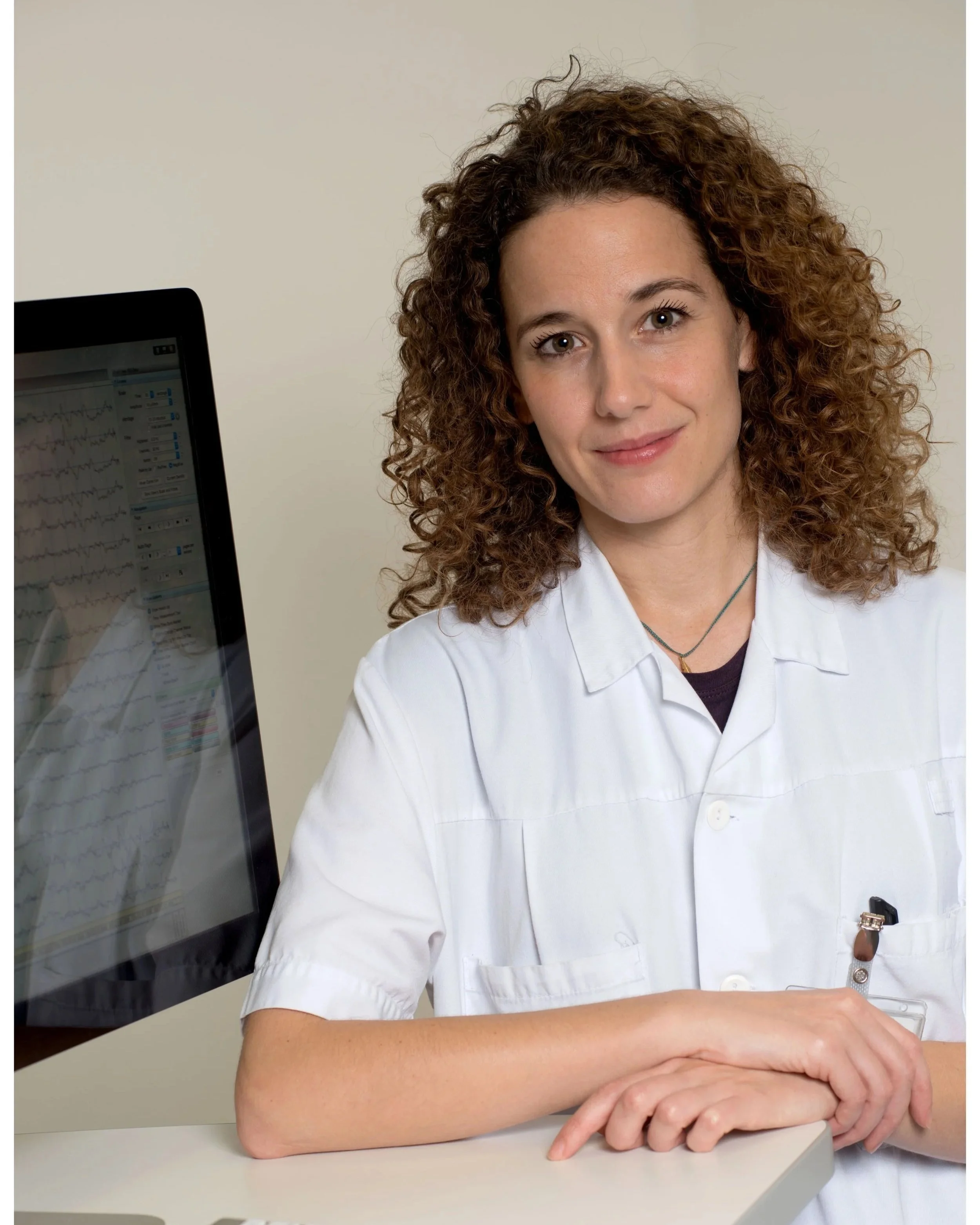
Dr. Francesca Siclari
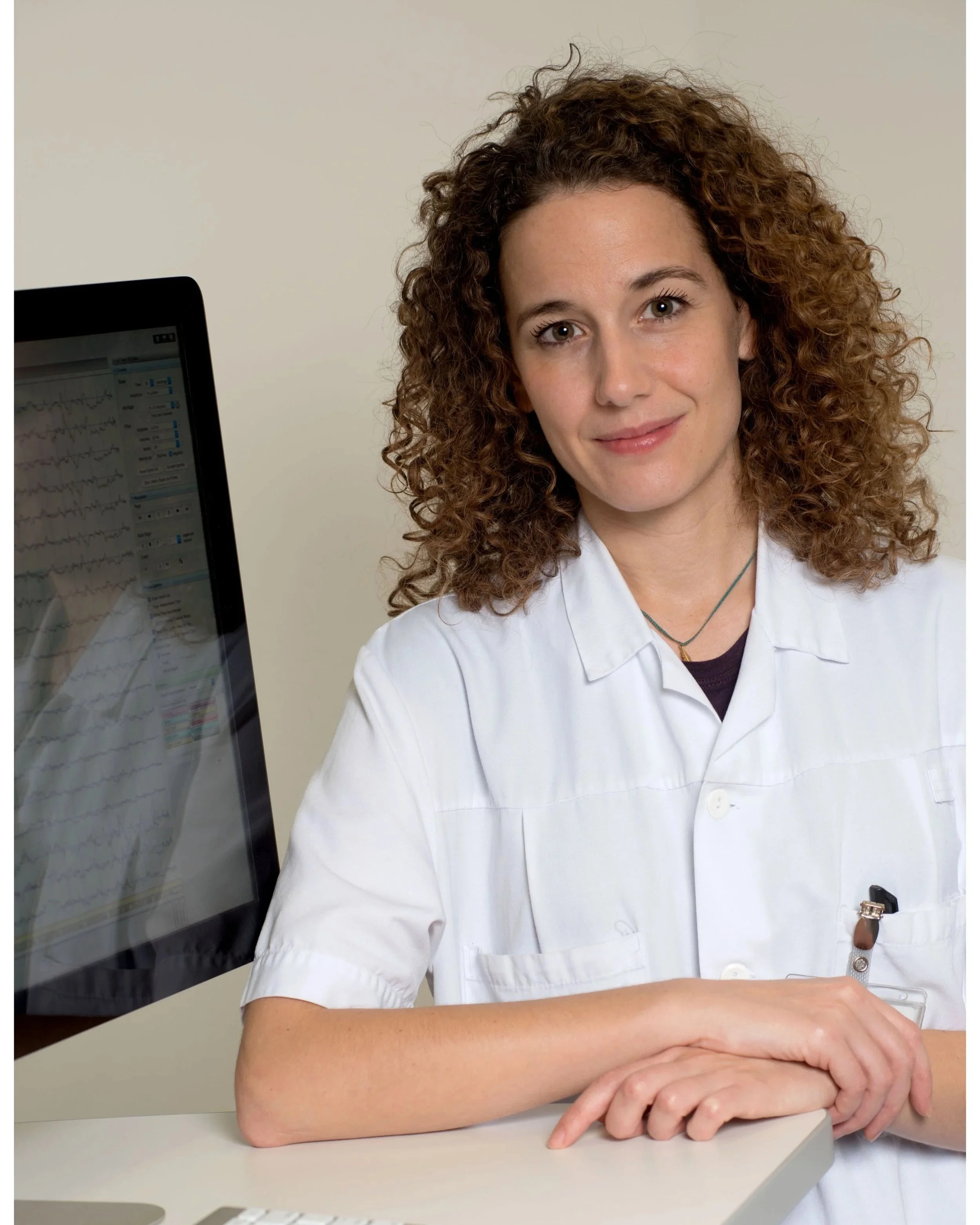
Group Leader, Netherlands Institute for Neuroscience, Amsterdam
Postdoctoral Fellow, University of Wisconsin-Madison
MD, Specializing in Neurology, University of Geneva and University of Lausanne
Dr. Francesca Siclari is drawn to the hidden parts of the human experience: the swirling thoughts, images, and sensations that stir in our minds while we sleep, yet seem to slip through our fingers the moment we try to grasp them. She confronted this feeling of reaching for something just out of reach after experiencing a migraine that temporarily left her unable to speak while sparing her ability to understand language. This experience plus her natural curiosity about medicine, having been raised by a surgeon father, led her to neurology, and eventually neuroscience. Today, Francesca is a group leader at the Netherlands Institute for Neuroscience in Amsterdam, studying the neuroscience of dreams and consciousness.
Francesca first pursued a career in medicine. She trained at the University of Geneva in Switzerland, specializing in neurology at the University of Lausanne, and also gained some clinical training in sleep medicine and electroencephalography (EEG) at Zurich University Hospital. EEG is a noninvasive technique that uses small electrodes attached to the scalp to record the brain's electrical activity. By recording EEG during sleep in patients with sleep disorders, Francesca could observe brain wave patterns that shift as they move through different stages of sleep. Yet, Francesca grew increasingly frustrated with the limits of what her clinical practice alone could do for patients with sleep disorders. Her patients frequently described having vivid dreams, nightmares, or hallucinations, and she found that medicine had limited means of assessing or treating these experiences. Near the end of her residency, Francesca hadn’t found a clinical subspecialty that captured her interest and began exploring research opportunities. She came across a paper from Dr. Giulio Tononi’s lab at the Center for Sleep and Consciousness of the University of Wisconsin, outlining sleep and dreams as model systems for studying consciousness. She saw how this line of research offered exactly what was missing from her clinical work: a practical way to capture and evaluate subjective experience through neural readouts. Francesca applied for and was awarded a Swiss National Science Foundation research fellowship to fund a postdoctoral fellowship in the Tononi lab. She excitedly moved across the world from Lausanne to Madison, and began working on a large project about dreaming.
Dreams, Francesca points out, are notoriously difficult to study. Unlike many other subjects of neuroscience research, dreams have no clear behavioral readout, and they're fragile—not reliably stored in memory once someone wakes. Dream experiences also vary enormously from person to person, and even finding the right vocabulary to describe them can be a challenge in itself. Previous studies linking brain activity to dreaming were limited by small sample sizes. Most studies also relied on traditional EEG recording methods that used only a handful of electrodes, limiting the spatial resolution needed to pinpoint which specific brain regions are active during dreaming. Francesca's postdoctoral project at the University of Wisconsin was built to go big, using a high-density EEG system with a 256-electrode net covering the participants’ head, cheeks, and part of the neck, and sampling dream experiences several hundred times. With this technique, Francesca was able to measure brain-wide electrical activity with greater spatial resolution than conventional EEG during sleep and wake periods. She acquired data from participants who spent multiple nights sleeping in the laboratory. They would be awoken every 15-30 minutes, across sleep stages, and asked to recall their most recent dream experience all while undergoing high-density EEG recordings.
Francesca and her colleagues discovered that when individuals reported having a dream experience, their EEG recordings showed localized activation of posterior brain regions, including sensory areas compared to when no dream experience was reported after an awakening. This pattern held across different sleep stages—both rapid eye-movement (REM) sleep, where there is global fast wake-like brain activity, and non-REM sleep, where slow brain activity dominates. Within the activated sensory regions, the correspondence between dream content and waking brain function was striking. When participants reported faces appearing in their dreams, the fusiform face area, the same region that activates when we see faces while awake, lit up. Without a face, that activation dropped. Francesca now had evidence that dreaming uses neural machinery that overlaps with waking perception, which offered a rare window into the neuroscience of consciousness. Watching this correspondence emerge, she says, felt like something close to magic.
After her postdoc, Francesca joined University Hospital in Lausanne, Switzerland, as a neurologist, and also started her own independent research group, thanks to competitive career funding from the Swiss National Science Foundation. She tried to incorporate her research expertise in her clinical practice. She began speaking with patients differently, trying to give their dream experiences a place within the classification of their sleep disorders, which she noted still don’t formally include dreams. Francesca often spoke with patients who insisted they hadn't slept for an extremely long time, even when this was physiologically implausible, given that these patients were still alive. Through clinical sleep studies and EEG recordings, she confirmed that these patients were indeed sleeping, but that locally, their brain activity looked more "awake" during sleep compared to a typical sleeping brain. This finding grounded her patients’ subjective complaints in an actual biological phenomenon, which could ultimately contribute to more targeted treatments.
Francesca also became particularly interested in parasomnias—sleep disorders, such as sleepwalking, that involve abnormal behaviors, movements, emotions, and perceptions during sleep, falling asleep, or waking. Using high-density EEG recordings in sleep studies of sleepwalkers, the Siclari group discovered that brain activity underlying conscious experiences during sleepwalking looks strikingly similar to brain activity underlying dreaming. This includes high-amplitude slow waves in the front of the brain, combined with activation of sensory regions in the posterior cortical hot zone, which some researchers consider a candidate for the seat of conscious experience. Through detailed interviews with sleepwalkers, Francesca found that a wide range of consciousness can be experienced when sleepwalking. Some patients act entirely automatically with no awareness at all, while others report vivid experiences as if they were awake inside their own dream. This spectrum of experiences suggests that consciousness does not require full wakefulness, it just requires the right parts of the brain to be activated.
Wanting to expand her research programme, Francesca applied for and was awarded a highly competitive European Research Council Starting Grant. This funding enabled her to establish the Sleep and Dreams Lab at the Netherlands Institute for Neuroscience. Day-to-day research looks different for the Siclari group compared to colleagues working with non-human animal models. Participants join sleep studies, where they spend nights in soundproof, light-controlled rooms designed to feel more like modest hotel rooms than clinical spaces. They wear a high-density EEG head cap with sensors tracking their heart rate, muscle tone, and eye movements. Computerized alarms wake them at intervals, and they’re prompted to report what was just going through their mind. Physiological signals are then processed and linked computationally to the coded dream content. Some of these studies are now shifting toward more ecological, at-home setups as well. The members of the Siclari group who conduct these studies come from a wide range of backgrounds, including neuroscience, bioengineering, medicine, and chemistry.
Looking ahead, Francesca wants to push further into the circuits underlying dreaming and consciousness. Beyond sleep itself, she's drawn to extending her research into imagination, creative processes, and hallucinations, asking how dreams fit into that broader landscape of consciousness. When asked what she might have pursued instead of medicine or research, Francesca pointed to journalism or literature, or anything that would let her chase the same question that has driven her all along: what is the subjective human experience, and how can we capture it?
Find out more about Francesca and her lab’s research here.
Listen to Margarida’s full interview with Francesca on February 16, 2026 below!