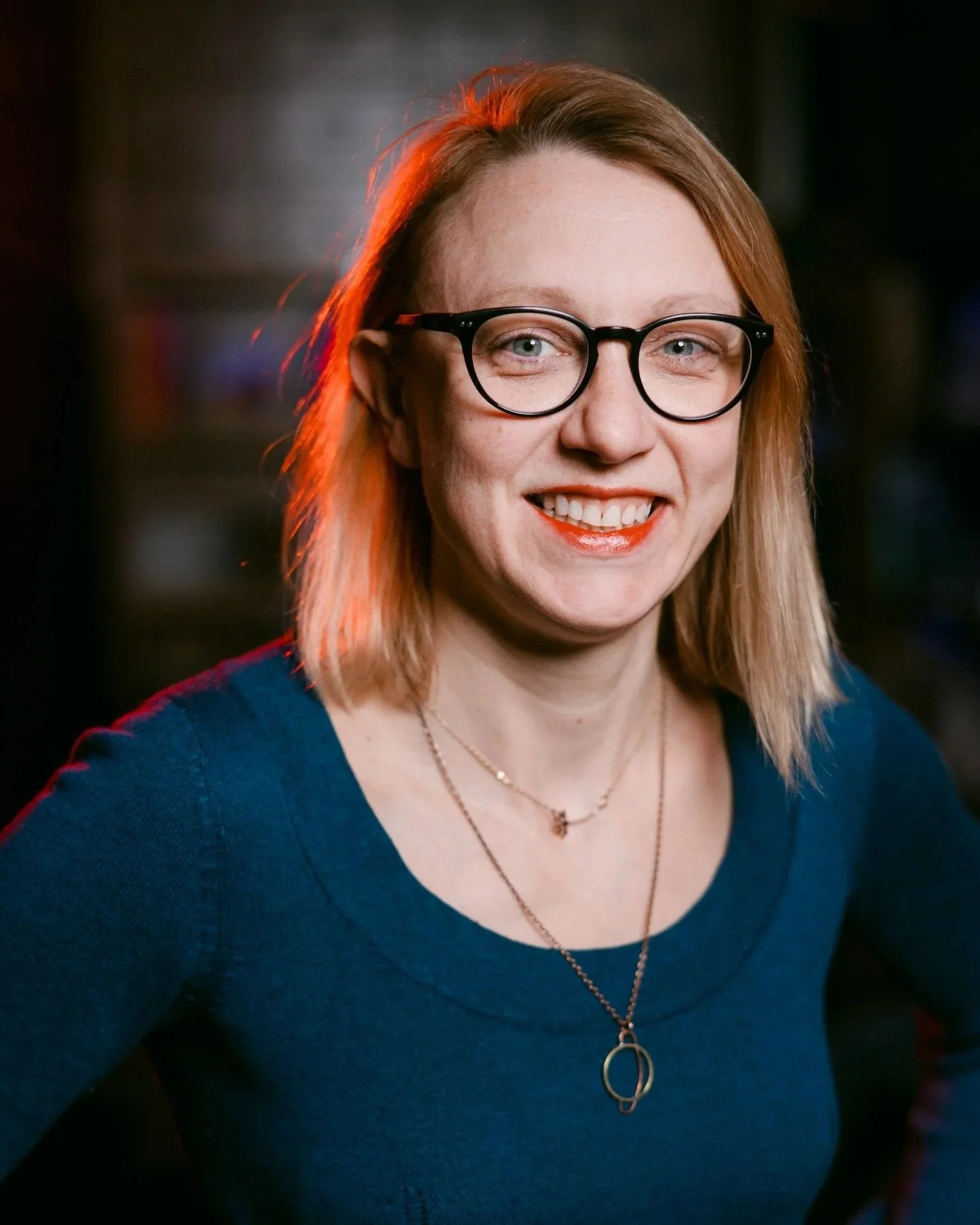
Dr. Ann Kennedy

Associate Professor, Scripps Research
Postdoctoral Fellow, Caltech
PhD, Columbia University
Growing up, Dr. Ann Kennedy’s world was framed by the logic of engineered systems. Her mother was an assembly coder, designing early operating systems for ATMs and writing programs on punch cards. But Ann carved her own path, combining her early love of mathematical precision with her fascination with biology. Today, as an Associate Professor of Neuroscience at The Scripps Research Institute in La Jolla, California, Ann combines theory with large-scale data to understand the neural basis of social behaviors. Her work stands out for its creative application of mathematical tools in biology, and for integrating internal states and molecular signaling into standard theories of network computation.
From an early age, Ann was encouraged to think like an engineer. Her path into science began at a magnet school for STEM, but she gradually found herself dissatisfied with studying the "made-up conventions” of programming. She was far more captivated by the deep mysteries of nature, from the origins of life to the staggering diversity produced by evolution. In high school, she took a course on DNA biology and landed a technician job in a stem cell biology lab in Washington, D.C. There, she heard scientists describe the “intricate molecular machines” that animate living cells. While her parents encouraged her to pursue a quantitative major in college, Ann found a compromise in a bachelor’s degree in Biology and Biomedical Engineering, using mathematical tools to study biological systems. Equations, she realized, left no “wiggle-room”: if a biological behavior did not match predictions from a mathematical model, it meant a piece of the puzzle was missing. After multiple research internships and a senior thesis in theoretical neuroscience, Ann began to consider a career in academia and applied to graduate school.
Ann moved to Columbia University for her PhD, joining the lab of Dr. Larry Abbott, a pioneer in theoretical neuroscience. She initially worked on recurrent neural network models, whose connectivity could be trained using machine learning to solve simple tasks. But she soon felt a deep disconnect between these abstract models and the function of real neural circuits. When Larry presented data on neural recordings in electric fish, collected by a collaborator Dr. Nate Sawtell in the department, she decided to work on that data instead. Similar to echolocation in bats, electric fish navigate by emitting electrical pulses and listening to the “echoes” of electrical fields as they are distorted by objects and organisms in the water. But the fish’s own electrical discharges create large sensory artifacts that could drown out external signals. Ann showed how the architecture of the electrosensory lobe, a specialized structure in the electric fish brain, provides an elegant solution to sensory interference. Using a copy of the fish’s motor command to create a “negative image” of the self-generated signal, its brain effectively subtracts out the predictable sensation to expose the vital, unpredictable echoes from the environment, much like filtering out the sound of your own footfalls.
Towards the end of her PhD, Ann started to notice that while neuroscience had well-established frameworks for sensory processing and motor control, theories of internal states like motivation and emotion remained comparatively nebulous. She was inspired by Dr. David Anderson’s talk at the Computational and Systems Neuroscience (COSYNE) conference, where he showed that optogenetic stimulation of neurons in the ventromedial hypothalamus could trigger aggressive behaviors in male mice. [To learn more about the story behind this, check out our profile of Dr. Dayu Lin!] As David’s lab was beginning to record neural populations using miniature head-mounted microscopes along with behavioral videos, they were looking for people to tackle the computational challenge of big datasets. Ann thus moved to Caltech for what turned out to be a very productive and scientifically impactful postdoctoral position in David’s lab.
In one of her first postdoctoral studies, Ann, along with her experimental collaborator, examined how social and sexual experience refines neural representations in the hypothalamus. They found that sexually immature male mice do not attack “intruders” but tend to sniff them curiously. Imaging in the hypothalamus revealed largely overlapping neural responses to different social partners. But this changed dramatically after mating experience, leading to distinct neural ensembles encoding male versus female conspecifics, and to the emergence of male-directed territorial aggression. In a follow-up study, Ann worked with a graduate student to understand how internal states, such as agitation following a predator's vocalization or motivation to find a mate, could be sustained over minutes. They used dynamical systems techniques to show that activity in the hypothalamus acted as a “leaky integrator.” Activity in hypothalamic circuits could accumulate and persist for minutes, scaling aggression with the level of threat perceived and tuning an animal’s willingness to fight. Together, these findings revealed the plasticity of evolutionarily ancient circuits, and that “innate” behaviors are flexibly shaped by experience.
Despite several high-impact papers and her ability to bridge theory with biology to tackle challenging scientific questions, Ann found it tough at first to land a tenure-track faculty job in computational neuroscience. As a theorist who had often adapted existing methods to understand cutting-edge data, rather than develop new tools, she faced some skepticism during chalk talks. She was advised to speak “less like a biologist” and “more like a theorist.” For Ann, who had been primarily motivated by biological questions rather than pure mathematics, this feedback was disorienting. It took time and practice to reframe her work for different audiences. She argues, however, that such a misalignment of expectations can hamper the success of theory-experiment collaboration, noting that while experimentalists are hearing the call for more theory, the incentives for theorists are still skewed toward novel methodology rather than engaging with the nuances of biological data.
After two years of navigating the academic job market, Ann eventually started as an assistant professor at Northwestern University, Chicago in 2020. She later moved to Scripps Research with tenure in 2024, mainly drawn back to California’s sunny weather and outdoor hiking opportunities. In her own lab, she has expanded focus beyond the hypothalamus to identify fundamental organizing principles of neural systems. One line of research in the lab focuses on how biological heterogeneity, such as diverse cell types, is a computational feature that enhances the capacity and flexibility of neural circuits. Her lab also studies how neuromodulators can dynamically shift network function by altering neuronal properties. In recent collaborative work, they uncovered how neuropeptide signaling enables animals to prioritize different competing needs such as food-seeking, pain relief, or defense, depending on their internal state. One such pathway enables hunger or predator cues to suppress coping behaviors in chronic pain and prioritize foraging or escape; another modulates hypothalamic circuits to increase aggression after periods of social isolation. Ann is interested in understanding the organizational logic of molecular controllers of neural function and views these as "baked-in" genetic solutions shaped over evolutionary timescales.
Throughout these scientific milestones, Ann navigated a period of profound personal struggle that remained hidden from her colleagues for years. Just as she was starting graduate school, her mother was diagnosed with early-onset Alzheimer’s. For the first few years of her PhD, Ann felt lost, struggling with the transition to graduate school and agonizing about being away from home during a difficult period for her family. Shortly before her qualifying exam, her father was hospitalized for cancer surgery and Ann returned home to provide the intensive care needed by her mother. When she returned to New York a week later, exhausted, she performed poorly on her exam but told no one about the crisis she was managing. It was later after meeting her husband that she eventually learned to reach out and ask for the kindness and space she needed. Her mother passed away in 2017, just as Ann was finishing the proofs for her first postdoc paper. Looking back on those years, Ann emphasizes that doing science requires a massive amount of support and a commitment to one's own well-being. She recalls the advice of her PhD advisor, Larry Abbott, who reminded her during the stress of the job market that science is "supposed to be fun". It was the main reason she kept coming back to it.
Ann’s career is built on a strong conviction that for theory to matter, it must be rooted in the “messy” complexity of biology. Her work also underscores the role of internal states as dynamical forces embedded in neural circuits and shaped by evolution. The same sensory world can elicit different behaviors depending on internal conditions and history that are often invisible from the outside. These internal states—stress, insecurity, resilience, curiosity—shape each of our own personal and scientific trajectories. Ann’s work suggests that biological complexity is not a deviation from clean computation, but the source of its remarkable flexibility.
Find out more about Ann and her lab’s research here.
Listen to Meenakshi’s full interview with Ann on October 30, 2025 below!